Showing posts with label cocktails. Show all posts

Thursday, June 27, 2013

Cocktail gets crafty ... and frisky

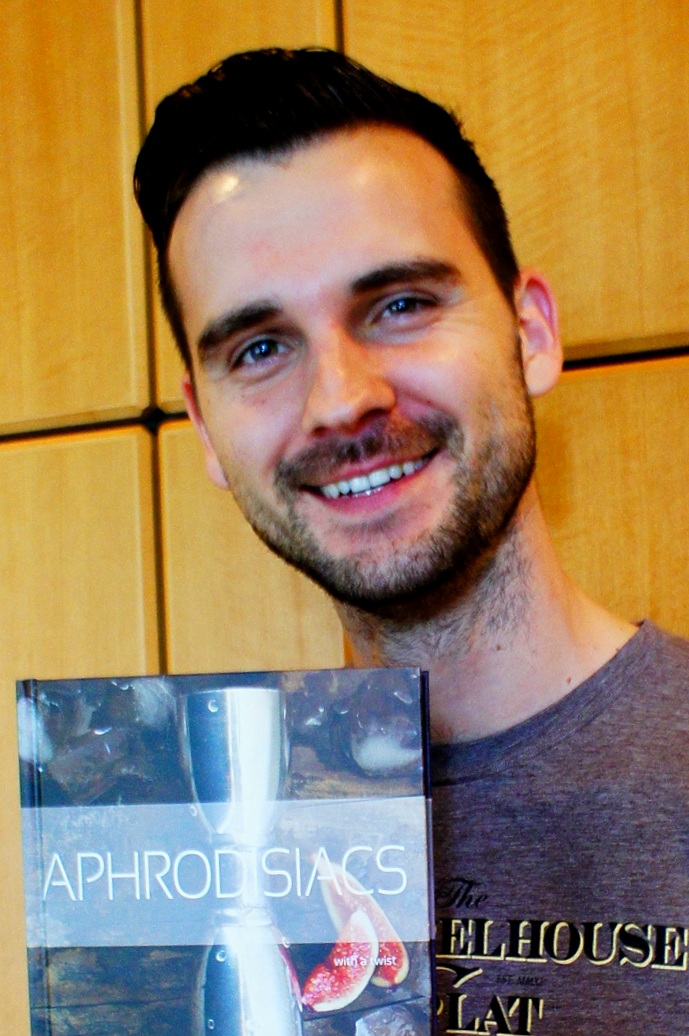
Mark w book.JPGThe cocktail shelf is getting crowded! We wrote last month about two Negroni books; we've got books galore about seasonal cocktails lying around from national stars like Katie Loeb and local cocktail mavens like Maggie Savarino. There isn't a self-respecting saloon in Seattle that doesn't have a "Craft Cocktail" list to upsell from a vodka-tonic to some lavender-infused concoction that takes ten minutes to prepare.

Then you've got all the producers of specialty liqueurs (St. Germain, to name just one) with recipe books of their own. A home bartender can get seriously ivolved with do-it-yourself bitters, homemade syrups and pickled garnishes. And the mixologists! A regiment of "behind-the-bartists" eager to show off their inventiveness.

Here's one of the best: Mark Sexauer, an award-wnning professional bartender, Seattle-based brand ambassador for Bacardi, who has turned a hundred or so original drink recipes into a handsome hardcover book titled Aphrodisiacs With a Twist. The book's premise is the well-known observation that alcohol is a social lubricant that can "elicit and heighten the sexual experience."

For example, Sexauer's take on the classic Manhattan, which he calls "Tastes Better in Bed," substitutes a homemade reduction of red wine and lime leaves for the traditional vermouth, then adds a splash of orange cordial and a dash of chocolate bitters. Then there's the "Bastadro," which takes four ingredients, including a sweeter red wine syrup, a vermouth called Cocchi Americano and tequila.

Nothing particularly aphorodisiac there? Try this: the Roy and Gouda.

Many cheeses, Sexauer points out, "can resemble the scent of a woman and can be stimulating for both sexes." The active ingredient is phenlethylamine (also found in chocolate, by the way), which is related to the release of endorphins. Here's where it gets all Modernist: Sexauer makes a foam with smoked gouda, olive oil and heavy cream, pours the mix into a nitrous oxide canister to freeze it, then squirts fanciful shapes onto a baking sheet. As you drink the cocktail (a scotch & vermouth concoction resembling a Rusty Nail), the cheese begins to thaw. "It should be the last thing you taste."

The photographs, by Charity Lynn Burgraaf, (styled by Kimberly Swidelius) do a great job of highlighting the color or key ingredients of the cocktails.

Aphrodisiacs with a Twist, 256 pages, $24.95

Friday, February 1, 2013

Be still: how to make Big Gin

Let's begin by reassuring the State Liquor Board and the federal revenuers that the "still" in the photo is for show-and-tell only, acquired from PelletLab.com so that Ben Capdevielle could demonstrate how distillation works. The botanicals in the boiling retort are real, though. It's a dog-and-pony show that Capdevielle took on the road this week for a class in gin-making. The real still, inside a grey clapboard house in Ballard, is a 100-gallon copper job from Vendome in Louisville, KY, a part of the country where distillation (licit and illicit) is an industry with a cultural history as important as, say, aerospace is out here.

The product of the legal effort (legal since the state gummint eased up on craft distilleries in 2008) is called Big Gin, produced by Capdevielle and his gang under a corporate umbrella named Captive Spirits. Big Gin is an aromatic spirit that falls into a category of gin generally referred to as "London Dry." That is, it's not overly sweet even with lots of juniper and orange peel in the nose. Compared to, say, Bombay Sapphire, it has nowhere near the perfume; it has none of the rose-water and cucumber aromatics of Hendricks. Captive spends more than other local craft distillers on its clothes: its gin is hand-bottled and sports an elegant label (by Chris Jordan of Shipwreck Design). All those botanicals, not cheap, either.

Captive will shortly release a second gin, aged in used bourbon barrels. The aging--a typical technique of a gin category known as "Old Tom"--mellows the flavors a bit and adds a hint of golden color. But the feds won't approve labels for gin that even suggest "aging," so the label will read, simply, Old Tom.

Capdevielle teamed up with the folks at Seatown (Tom Douglas's tourist-oriented snack bar at the Market) for the cocktail class. And using the show-and-tell still, with its juniper berries and botanicals bouncing happily in the retort, he explained that craft distillers use neutral, industrial-strength corn-based ethanol and infuse it with flavors. The orange esters, for example, dominate the first part of the distillation; how prominent should those flavors be? Each distiller's "recipe" (how much of this, how much of that) remains a closely guarded secret, even as their trade association, the Washington Distillers Guild, works with the Liquor Board to expand access to out-of-state markets.

Monday, December 10, 2012

Concocting Cocktail Infusions

  
Mi-Suk Ahn, bar manager at BOKA.Photo courtesy of Hotel 1000.
Gracious and charming, BOKA's bar manager Mi-Suk Ahn reminds the three dozen women (and three gents) attending a class on "Holiday Infusions" at Hotel 1000 that this should be as easy as flipping an egg.

The ingredients are at hand: herbs and flowers (hibiscus, thyme, rosemary, basil); fresh fruit (kumquat, pomegranate), frozen fruit (blueberries), dried fruit (figs); spices (vanilla, cinnamon, cloves). An array of not-quite premium liquor (because it would be a waste to use the very best stuff): vodka, bourbon, gin, rye.

It's not rocket science. Put ingredients in a jar, add booze, stir, cover and wait. How long depends on what's in the jar. Herbs only take a few days. Spices and fruit take longer.

You might need a bit of simple syrup to sweeten things up, a bit of citrus for acidity; that's your personal choice, if you've got the palate. For my palate, the danger was the overpowering flavor of cinnamon.

Can you infuse something that tastes like a Negroni (normally gin + sweet vermouth + Campari)? Mi-Suk says sure: hibiscus, kumquat, figs, and plain Gordon's gin. Wait two weeks. We'll report back.

Thursday, May 17, 2012

Duke's new slant on Happy Hour


Katy's Naughty Lemonade
Classic drinks, highballs to be specific,  served in slanted glasses. That's all there is to it. Seven of them, from a traditional bloody mary to "All the Rootie" (bourbon & root beer). 

Seven new Happy Hour sliders, including a caprese salad of Laura Chenel goat cheese with homemade pesto and a sliced tomato on a mini flour tortilla ($2.50), Bay shrimp slider ($3), Dungeness Crab & avocado slider ($3.90).

Those old-timey plastic animals are supposed to remind you which one's your drink. After the third one, they just got me confoozled.

Can't beat the Lake Union waterfront on a fine afternoon. 

Duke's Chowder House at Chandler's Cove on Lake Union, 901 Fairview Ave. N., Seattle 206-385-9963  Duke's Chowder House (Lake Union) on Urbanspoon

Sunday, December 4, 2011

My (Bitter) Amigos

There's a whole tequila thing, I'm finding out. On Queen Anne, the latest place is called Mezcaleria Oaxaca, a distill-your-own sister to Carta de Oaxaca in Ballard. Jay Friedman reviews it, favorably, on Voracious.

There's a lot of cactus out there, just waiting to be distilled, and not just in Mexico.The cactus in the photo, in case you're wondering, was growing in Italy, on the limestone plateau called Murgia, in the region of Puglia (the heel of the boot). Those catci, they're everywhere! Just like grapes.

Sure, there are minor differences, but when push comes to shove, basically, the cactus gets chopped up, boiled and distilled. (I can hear the purists hissing.) The Italians stick with grapes, but in Mexico, the firewater called tequila has always been a point of pride.

The folks at Riazul were kind enough to send me a vial of their Reposado, along with a recipe sheet.

What caught my eye tonight was a cocktail called the Bitter Amigo, equal parts reposada, dry vermouth and (this is the part I noticed) Campari. Shades of the classic Negroni! The traditional Negroni is made with equal parts gin, sweet vermouth and Campari. Here, because the Riazul Reposada is already on the sweet side, the less aggressive dry vermouth is called for.

I'm a purist when it comes to cocktails, but I could get along with this one just fine.

Saturday, October 15, 2011

What's in a name?

Flying across country, 30,000 feet or so, head above clouds, Bloody Mary in hand, iPad on lap. Wi-fi as well, bouncing around the ionosphere @ $12.95 for the duration of the flight. And so, in this contemplative mood, I ponder a few questions.


Names, for example. Jamie Boudreau, barman extraordinaire, has a new place on Capitol Hill which John Sundstrom once called Licorous. In French, that would be liquoureux, sweet. In English, it becomes a pun on licorice. Boudreau continues the game. He named his place, but the logo, as you can see, is a cannon. Does this mean he can't spell? Or does the name signal an intention to follow a strict canon of cocktails? Or maybe Nikons aren't welcome? The subtitle of the (very pleasant) bar is Whiskey & Bitters Emporium, which has a a bit of an Old-Fashioned (get it?) ring to it. Still, I wish the graphics designer or whoever spec'd the Classic Typerwirter font, had actually spelled it Cannon.

That confusion isn't nearly as dumb as the new pizza joint on Queen Anne, the one that took over from Sezoni. Yes, Domino's sells lots of pizza, but calling your shop Domani isn't going to get you a lot of accidental walk-ins since there's a real Domino's about half a mile north. I've got to think it was that the owner liked the Italian sound of Domani without realizing that domani is the Italian word for tomorrow. Do you really want your pizza delivery business to be called Tomorrow? As Annie sings it, your pizza's only a day way. The Italian version of the lyrics: tomorrow never comes.


- Posted using BlogPress from my iPad

Friday, October 7, 2011

Behind the Bar:

Dry Soda, Perlini, Scrappy

We Americans spend more money on soda than on real food. And it gets worse when you include flavored waters, energy drinks, and fruit juices, not to mention coffee and tea, and leaving aside beer, wine and spirits. We are a nation built on liquids enhanced with artificial flavors and sweeteners, and we're getting bulkier every day.

Sharelle Klaus
Into this fray, six years ago, stepped a local woman, Sharell Klaus. A foodie, yes, but primarily a high-tech consultant with four little kids. She set out, very deliberately, to create a new category of "natural" carbonated beverages (water, cane sugar, natural flavoring, and phosphoric acid) that would pair with food. She called it Dry Soda.

At the time, there were basically three flavors of canned soda: cola, lemon-lime, and root beer. So she thought about it for a while and came up with four candidates: Kumquat, Lavender, Rhubarb and Lemongrass. (She would soon add Vanilla and Juniper Berry, drop the Kumquat when it turned out that not many people knew what a kumquat was; she substituted Blood Orange.) Each flavor required a lot of experimental formulation in her Tacoma kitchen, a thousand batches each, Klaus says. 

Now 42, she's grateful for the guidance she received from a food scientist and a beverage industry consultant. Turnstyle Studio of Ballard, back then a startup as well, designed the appealing logo. Dry's flavors are developed in association with a company in California; the bottling is handled by an outfit in Portland. "Building a beverage brand is very expensive," Klaus acknowledges, so, in addition to its own sales team, Dry Soda has hired a savvy, $2 billion national food broker, Acosta, to make sure Dry gets onto the right grocery shelves and into the right restaurants (like the French Laundry).

There's an air of Energizer Bunny around Klaus. On the day she was named one of Seattle's 15 Women of Influence by Puget Sound Business Journal, she was launching a new flavor of soda, Wild Lime (think 7-Up on steroids) at Dry's headquarters in Pioneer Square, then hopped the red-eye to South Carolina to launch a new venture with Urban Outfitters. She'd been hoping to run in the New York Marathon next month, and hired her daughter's soccer instructor to be her running coach, but she concedes she's run out of time. "I'll have to put off the Marathon until 2012."

And then we have Evan Wallace, former physicist and ex-software engineer, who lives in a condo at the Market and spends a lot time in his "living room" downstairs, the Zig Zag Café.

Evan Wallace at Zig-Zag
Wallace is a tinker and inventor with a fondness for bubbles and abhorence of flat Champagne. How to keep the sparkle in a sparkling wine? Icy cold temperature helps; an airtight stopper helps, but really, once the bottle has been opened, the only way to keep the contents perfectly fresh is to exactly recreate the conditions in the bottle before the cork was popped. Wallace's solution, patented as the Perlage system, is to encase the entire bottle in a clear safety enclosure, and then repressurize the headspace of the bottle to its original state. At $200, it's an item for serious consumers of fine Champage.

But wait, there's another product from Wallace's company that will add sparkle to your bar: it's called Perlini, a kit (in a Mafia-style metal attaché case) that includes a shaker, a pressurizer, and a dozen CO2cartridges. (Also $200.)  Here's a video that shows how the system works; here's another one of Seattle bar guru Jamie Boudreau using Perlini to make a sparkling Negroni.
Miles Thomas makes Negroni at Branzino

Boudreau's new place on Capitol Hill, Cannon, is also at the forefront of another trend for craft-cocktail bars: homemade bitters, which he keeps in glass pitchers atop the bar.

Finally, for bars that don't have the time to brew their own, there's Scappy's Bitters, a local company founded by Miles Thomas, who went from tending bar at Branzino to the forefront of the bitters trend. (Technically, if it doesn't contain bitters, it's not a cocktail.) But bitters have gone way past the dark-and-dodgy days of Angostura's, first concocted two centuries ago in South America and still brewed in Trinidad. Scrappy's comes in a handful of flavors (orange, lime, grapefruit, lavender, celery--ideal for Bloody Mary--and chocolate). Demand has been intense; Thomas keeps moving to bigger quarters (he's currently in Fremont) but the product remains handmade.

The Perlini allows bartenders to produced a greater range of flavors without resorting to traditional mixers. Dry Soda allows non-drinkers to enjoy the flavors as well. And Scrappy makes it all (bitterly) worthwhile.

Saturday, September 24, 2011

A Cocktail Contest, You Say? That's the Spirit!

Lots of new cocktails out there, lots of new cocktail-related concoctions. It's a huge new business, catering to fussy drinkers, bored drinkers, adventurous drinkers. We've got a series of posts about this in the pipeline (as it were). Here's the first, about the most traditional American spirit of all, bourbon.
Metropolitan Grill's head bartender Rob Nokes


Didn't we just do this? (Memory plays tricks on us professional drinkers, ya know.) But yes, we did, last July.

And now a new crop of entrants, and a new, custom-blended bourbon from Woodford Reserve. This year's version is a little less spicy, a bit lighter-bodied, yet still oaky in the nose. The GM of downtown Seattle's prime steakhouse, Josh Anderson, exec chef Eric Hellner, and the Met's sommelier, Thomas Price, headed to Versailles, Kentucky, earlier this season and made the pick at the Woodford distillery.

"Running out of glassware!" calls the creator of Manhattan #1, a 13-year veteran behind the bar named Steve Alexander. His concoction includes Fernet Branca, Peychaud bitters, a splash of Maraschino and an orange zert, kinda like a Negroni with bourbon instead of gin. "The most Manhattan-y," says a nearby discerning journalist. "The least bourbon-y," thinks another blogger.

There's another contender among the traditionalists: head barman Rob Nokes, using the robust Woodford Reserve, Lucid absinthe, Italian vermouth and Fee Brothers Cranberry Bitters. "It's a Sazerac-style drink," says Nokes, who's been taking care of bourbon connoisseurs at The Met for two decades.

And in the end, wouldn't you know it was the most traditional concoction that won. Bravo, Mr. Nokes! Thanks, Met Grill! The Met Manhattan No. 5 will be available for $14 starting this weekend; it's a steal, considering that last year's winner cost $15. ("It's the economy," says GM Anderson.)


Steve Alexander at work

Two final observations before we stumble off into the night. First, three of the five contestants were professional bartenders, and their entries were along classic lines. Two were by Met Grill servers, and they veered severely toward the sweet side. Does this mean that servers think customers want sugary drinks? To be followed up.

Second, there are now 4.7 million bourbon barrels in the state of Kentucky, several hundred thousand more than there are actual residents in the state. The president of the Kentucky Distillers Association says there's "an explosion" of small-batch and single-barrel products. Good to know.

"Bourbon is a great value," says Met Grill GM Anderson. A premium bourbon costs less than half as much as a single-malt Scotch. The winning Manhattan No. 5 goes on sale this weekend for $14, down a buck from last year.

Metropolitan Grill, 820 2nd Ave. Seattle 206 624 3287


- Posted using BlogPress from my iPad


Saturday, October 1, 2005

Back to the Bars!

Behold the cocktail, embodiment of western civilization. Evolved from ancient technology (distillation was known to Babylonian alchemists 25 centuries ago; medieval pharmacists concocted flavored alcohols) and enhanced by contemporary imagination, designer drinks have graduated from patent medicine to emblems of sophistication.

The latest spot to cater to our fascination with retro nostrums is Suite 410, around the corner from Toi on the slippery slope between the Mariners Store and Rochester Big & Tall. Toi's owners, Damon Maletta and Max Borthwick, had already demonstrated a knack for exotic beverages; their move to Suite 410 has left culinary pretensions behind to concentrate on beverages, period.

They hired drinks guru Ryan Margarian (remember when he was the barman at Zoe?) to develop a list of "resurrected" and "original" cocktails, and brought in Robert Hess (whose website, www.drinkboy.com, is the authoritative record for cocktail recipes) to train the staff in mixological history. The result is a lounge that's gratifyingly serious about its drinks-not in a snobby "battle of the premium vodkas" way, but serious like great restaurants. Serving a vodka-soda would be like the chef sending out an unadorned head of lettuce.

The "chef" at Suite 410 is Amon Mende, lately at Via Tribunale and remembered by downtown imbibers as Murray Stenson's talented understudy at Cafe ZigZag. No free-pours here; everything is measured into a mixing glass, some aromatic ingredients literally by the drop. Ice is added only when the blend is perfect. And worth the wait.

Suite 410 isn't a loss leader for a dance club with $1 well drinks. It isn't the waiting room for a restaurant. In fact, everything's the same price-$8.75. Steep but fair. I just hope the throngs of pretty young things packing the joint every night understand what they're in for-a lounge with real drinks that are hand-mixed, not squirted. High time.

Classic and fanciful names alternate on the drinks list. Have you tried a Blackthorn? Gin, Dubonnet and kirschwasser; it tastes like a Manhattan. The Corpse Reviver is lemony, with gin, freshly squeezed lemon juice, Cointreau, Lillet and a drop of Pastis. The Pisco Sour uses an organic egg white; a dash of Angostura bitters floats across the top, providing a fragrant accent of ... chocolate!

Amon and his coterie worship at the altar of Audrey Saunders, who opened her own bar, Pegu Club, in New York only weeks ago. She's the deity; they're the disciples. We're fortunate to have an outpost.