Let's begin by reassuring the State Liquor Board and the federal revenuers that the "still" in the photo is for show-and-tell only, acquired from PelletLab.com so that Ben Capdevielle could demonstrate how distillation works. The botanicals in the boiling retort are real, though. It's a dog-and-pony show that Capdevielle took on the road this week for a class in gin-making. The real still, inside a grey clapboard house in Ballard, is a 100-gallon copper job from Vendome in Louisville, KY, a part of the country where distillation (licit and illicit) is an industry with a cultural history as important as, say, aerospace is out here.
The product of the legal effort (legal since the state gummint eased up on craft distilleries in 2008) is called Big Gin, produced by Capdevielle and his gang under a corporate umbrella named Captive Spirits. Big Gin is an aromatic spirit that falls into a category of gin generally referred to as "London Dry." That is, it's not overly sweet even with lots of juniper and orange peel in the nose. Compared to, say, Bombay Sapphire, it has nowhere near the perfume; it has none of the rose-water and cucumber aromatics of Hendricks. Captive spends more than other local craft distillers on its clothes: its gin is hand-bottled and sports an elegant label (by Chris Jordan of Shipwreck Design). All those botanicals, not cheap, either.
Captive will shortly release a second gin, aged in used bourbon barrels. The aging--a typical technique of a gin category known as "Old Tom"--mellows the flavors a bit and adds a hint of golden color. But the feds won't approve labels for gin that even suggest "aging," so the label will read, simply, Old Tom.
Capdevielle teamed up with the folks at Seatown (Tom Douglas's tourist-oriented snack bar at the Market) for the cocktail class. And using the show-and-tell still, with its juniper berries and botanicals bouncing happily in the retort, he explained that craft distillers use neutral, industrial-strength corn-based ethanol and infuse it with flavors. The orange esters, for example, dominate the first part of the distillation; how prominent should those flavors be? Each distiller's "recipe" (how much of this, how much of that) remains a closely guarded secret, even as their trade association, the Washington Distillers Guild, works with the Liquor Board to expand access to out-of-state markets.
Friday, February 1, 2013
Wednesday, January 23, 2013
Tequilas at Cactus
Half a dozen tequila-based cocktails last night at Cactus in SLU. The occasion: the "unveiling" of Olmeca Altos 100% Agave Tequila, a handcrafted tequila produced in the heart of Los Altos, 6,500 feet above sea level in the state of Jalisco, Mexico, using artisanal ingredients and production methods.
The brand is distributed through PernodRicard, one of the world's largest drinks companies (Absolut, Jameson, Beefeater).
My favorite: the Teqroni, made with Campari, Punt y Mes and Olmeca Altos Plata.
On the right, Altos tequila's master distiller Jesus Hernandez; on the left, brand ambassador Steffin Oghene. Afro aside, he's a Scotsman.
Saturday, December 15, 2012
No Yquem for you!
| Pouring Chateau d'Yquem for a tasting. 2006 photo. |
The last time Yquem failed to release a wine was 20 vintages ago.
Location:
2 Le Bourg Sud, 33210 Sauternes, France
Wednesday, December 12, 2012
Tatoosh Bourbon Debuts at F.X. McRory's
| Tatoosh founders at F.X. McRory's |
And on 12/12/12, four Seattle guys came in with the first bottles of their new bourbon, named Tatoosh. No, not Paul Allen's mega-yacht. The Tatoosh mountains, the Tatoosh wilderness.
The bourbons and whiskeys are distilled under contract in Bend, Oregon (where there's plenty of golden grain and prisine waters from the Cascades), but it's a departure from the recent explosion of micro-distilleries that have set up shop in and around Seattle. On the other hand, after stocking well over a hundred bourbons, this marks the first time that a bourbon has actually launched at McRory's.
So it was a pleasure for owner Mick McHugh to be on hand as the first bottle of Tatoosh was slotted into its center spot between Tangle Ridge (a rye from Alberta) and Templeton (Prohibition-era rye from Iowa).
The Tatoosh is sweeter than most bourbons, which makes it a natural for the Manhattan (or "Tathattan," as they called it on opening night).
Tomorrow, the Tatoosh team roll out their brand at a dozen more eating and drinking establishments (Seastar, Sport, Roanoke Inn, 5 Point Cafe) and retailers (Wine World, Emerald City Spirits).
FX McRory's, 419 Occidental Ave. S, Seattle 206-623-4800
Monday, December 10, 2012
Concocting Cocktail Infusions
| |
| Mi-Suk Ahn, bar manager at BOKA.Photo courtesy of Hotel 1000. |
The ingredients are at hand: herbs and flowers (hibiscus, thyme, rosemary, basil); fresh fruit (kumquat, pomegranate), frozen fruit (blueberries), dried fruit (figs); spices (vanilla, cinnamon, cloves). An array of not-quite premium liquor (because it would be a waste to use the very best stuff): vodka, bourbon, gin, rye.
It's not rocket science. Put ingredients in a jar, add booze, stir, cover and wait. How long depends on what's in the jar. Herbs only take a few days. Spices and fruit take longer.
You might need a bit of simple syrup to sweeten things up, a bit of citrus for acidity; that's your personal choice, if you've got the palate. For my palate, the danger was the overpowering flavor of cinnamon.
Can you infuse something that tastes like a Negroni (normally gin + sweet vermouth + Campari)? Mi-Suk says sure: hibiscus, kumquat, figs, and plain Gordon's gin. Wait two weeks. We'll report back.
Location:
1000 1st Ave, Seattle, WA 98104, USA
Sunday, September 16, 2012
Drinking Lesson: Absinthe can get you hammered
Marteau is French for "hammer." It's also Gwydion Stone's brand of Absinthe, Stone being the founding member of an association called the Wormwood Society whose purpose is to educate bartenders and drinkers about the magic green distillate. Not an easy task, since competitors (virtually the entire alcoholic beverage industry, not to mention zealous government bureaucrats) are more than eager to demonize absinthe, ascribing to it every evil and unfortunate medical condition known to the planet.
Never mind that real absinthe, properly made, is a thing of beauty, "like drinking an Alpine meadow," as Stone put it last week to a dozen curious imbibers on the penthouse terrace of the Sorrento Hotel. It was the final session of 2012 for the hotel's popular series of monthly "Drinking Lessons," which resume next year on the second Wednesday of every month with two sessions a night in the hotel's elegant Hunt Club bar. Champagne, rare wines, tequila, rye, gin...an even dozen classes for $35 each, which includes an opening lecture, drinks, and Hunt Club bites.
Back to the drinking lesson for a sec. To sweeten the absinthe, drip some icewater through a sugar cube suspended on a slotted spoon above the glass. Don't set fire to the sugar! That's a bar trick from eastern Europe designed to camouflage counterfeit absinthe; the real stuff turns milky when water is added. Absinthe used to be cheaper than wine; that's why it was so popular during the Belle Époque, at the end of the 19th century. In its early years, until craft distilleries were legalized in Washington, Stone's Marteau was distilled under contract in Switzerland. Remember, it's a distillate, not an infusion. Now close your eyes and taste the meadow.
Program details and reservations for 2013 are here.
Sorrento Hotel, 900 Madison St., Seattle, 206-622-6400
Labels:
absinthe,
sorrento hotel,
Spirits
Location:
Seattle, WA, USA
Sunday, September 9, 2012
Who's Who in St. Emilion? Shh, it's Classified!
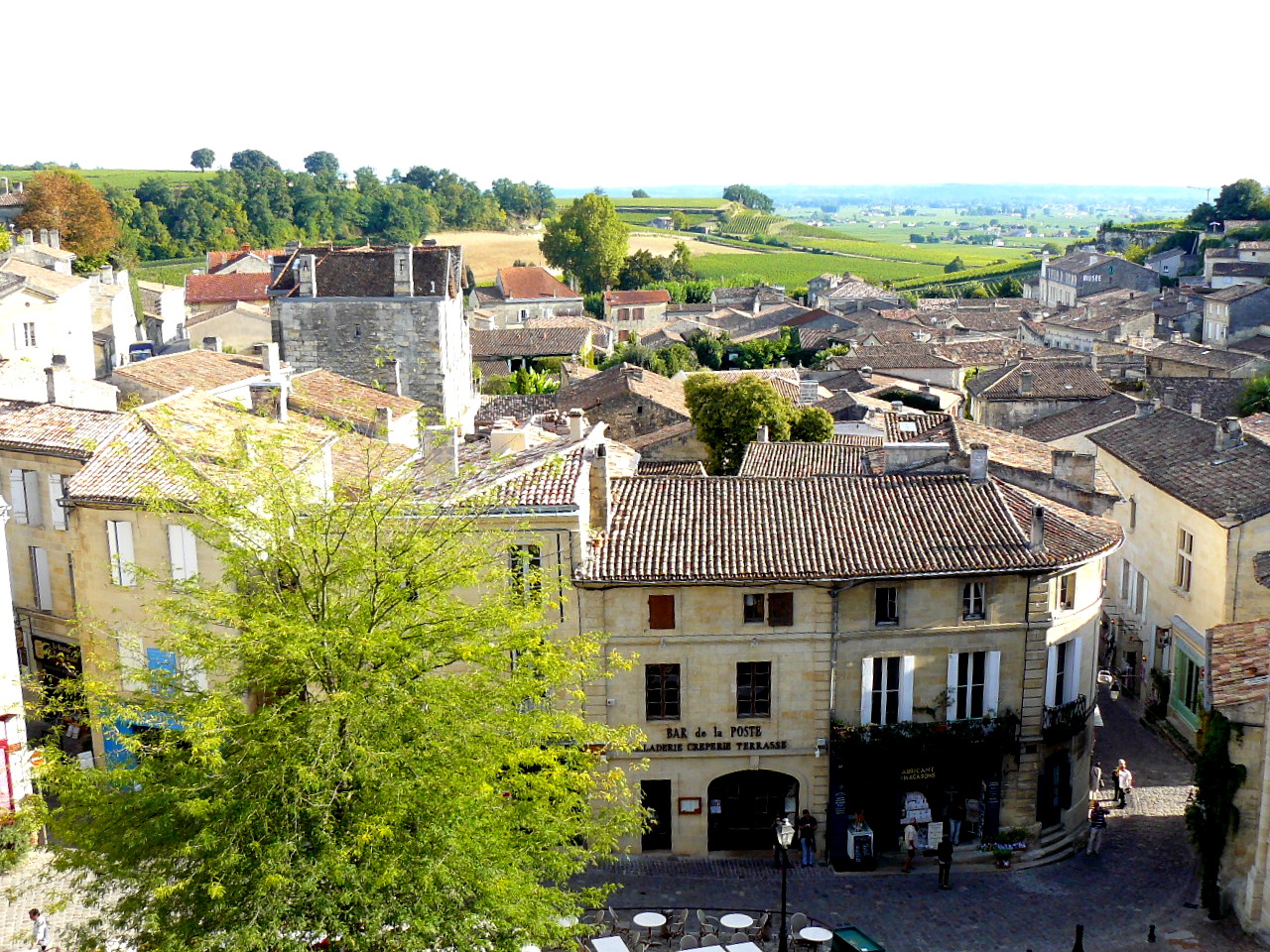
View from the hilltop: vineyards on the limestone slopes produce the best wine.
ST. EMILION, France--This village, 30 miles east of the Bordeaux city limits, encompasses just over 10,000 acres of vineyards (merlot, mostly), where some 70 of the best estates, located on the calcareous plateau overlooking the right bank of the Dordogne River, produce 10 million bottles of wine. It's a tiny part of what is generically called "Bordeaux," in reality a vast region that sends forth 700 million bottles a year, but it's got glamor and history, a couple of super-famous chateaux (Ausone and Cheval Blanc) and this amazing limestone village virtually unchanged since medieval times.
Once a decade, the local growers submit their wines for a ranking. This is virtually unheard of elsewhere in the region; in the Médoc, on the left bank of the river north of Bordeaux, the top châteaux were "classified" in 1855, and that's been that ever since. It was a ranking by market price at the time, and it's held up pretty well, even though it's also something of a self-fulfilling prophecy. But the vineyard owners of Saint Emilion agreed to put themselves through the wringer. The last time they did this, lawsuits flew in all directions, and it took years for the storm to abate. This time, the ranking was done by an independent panel of outsiders (still, all French), and the results are being met with applause.
Best news is that two excellent estates have been promoted to the very top of the classification (Premier Grand Cru Classé A): Pavie and Angélus.
Newcomers to the next notch down, Premier Grand Cru Classé B, were Canon-La-Gaffelière, La Mondotte, Larcis-Ducasse and Valandraud.
The new classification is a sweet victory for Gerard Perse, a supermarket magnate who bought Pavie in 1998 for $38 million. His predecessor, Jean-Paul Valette, was much admired for his consistent, understated style of wine making; Perse, on the other hand, wanted more concentration. In 2003, the year of the drought in Europe, the difference in style was the flashpoint of a controversy when the British wine writer Jancis Robinson wrote:
"Completely unappetising overripe aromas. Why? Porty sweet. Port is best from the Douro not St.Emilion. Ridiculous wine more reminiscent of a late-harvest Zinfandel than a red Bordeaux..."Needless to say, Robert Parker loved the wine. Also needless to say, that's what makes horse racing. If we all liked the same thing, we'd only need one thing.
Location:
Saint-Émilion, France
Subscribe to:
Posts (Atom)